
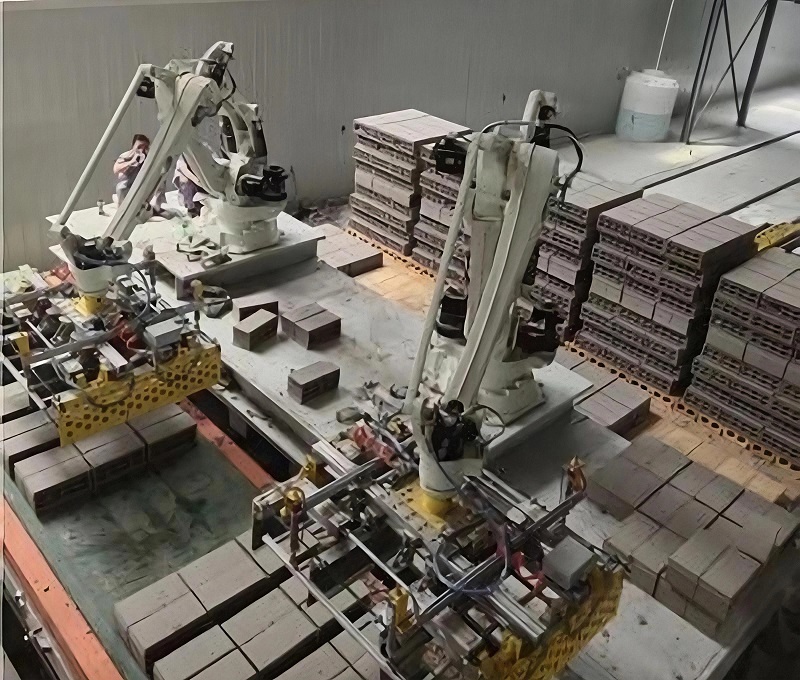
At present, two setting modes are adopted for tunnel kiln: mechanical setting and manual setting. Mechanical setting technology is mature for large‑and‑medium‑size flat‑roof tunnel kilns with high automation level. Setting pattern is highly dependent on setting machine and difficult to modify after confirmation, so it is hard to adapt to multiple product specifications. Manual setting is flexible, yet with high labor intensity and low productivity.
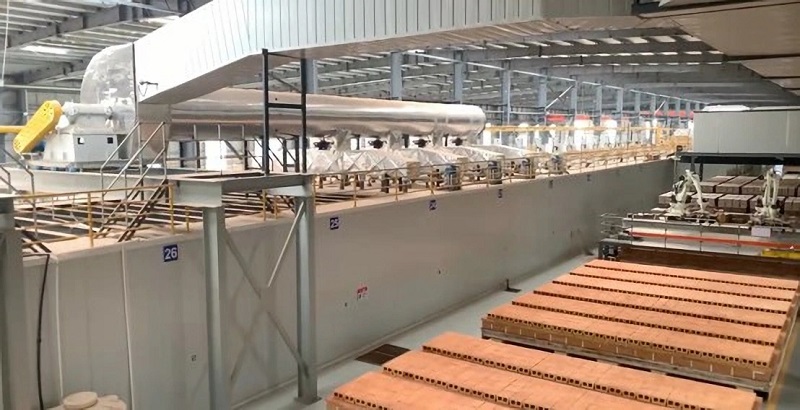
Stack stability is the prerequisite for stable tunnel‑kiln production. No matter which setting pattern is adopted, stacks must keep stable. During propulsion, kiln cars suffer thrust from pusher, friction from sand seal, track installation error and kiln‑car deformation, which cause certain shaking during movement. Ware stacks on kiln cars must have sufficient stability to avoid stack‑collapse accidents.
To guarantee stack stability, setting operation shall follow three principles: level, stable, straight.
‑ Level: kiln‑car deck and every layer of green bricks must be laid level to prevent tilting.
‑ Stable: each brick, each column and each stack shall be firmly placed.
‑ Straight: stacks shall be aligned vertically and horizontally. Stacks on all kiln cars form continuous straight lines to keep flue passages unobstructed.
English: Stacking density is defined as quantity of green bodies per unit volume. It is a comprehensive index reflecting flow resistance and heat‑transfer performance of ware stacks. Low setting density brings low flow resistance and good ventilation condition, as well as thicker hot‑gas layer favorable for radiative heat transfer. However, excessively low density reduces loading capacity and production output.
Setting density among different kiln cars shall not vary greatly in production. Specific setting density matches specific firing regime. For kiln cars with fewer green bodies, heat consumption is lower; lower firing temperature or shorter pushing interval shall be adopted to avoid over‑firing. On the contrary, longer holding time is required for higher‑density stacks.
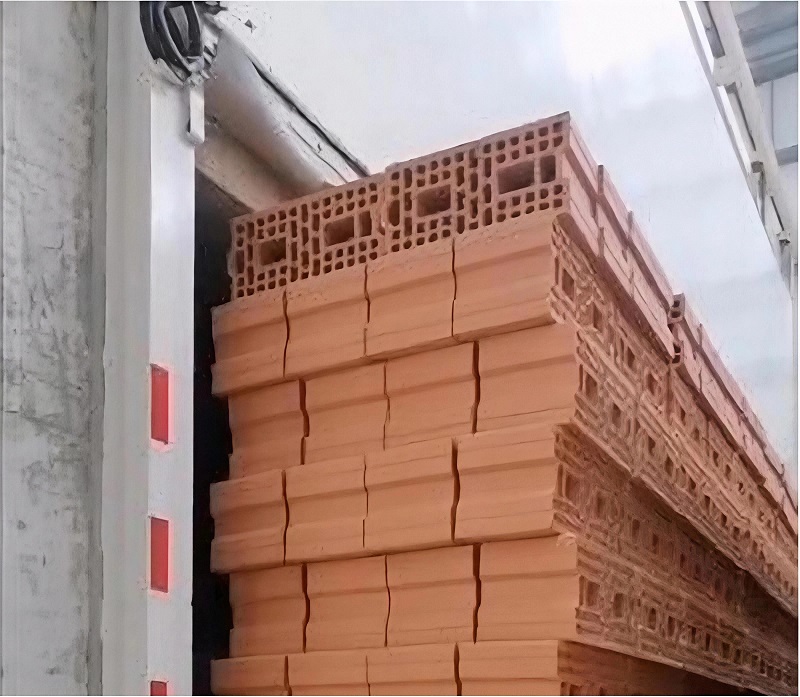
Due to limited cross‑section height of tunnel kiln, supporting piers are rarely used for ware stacks; uniform stacking pattern is adopted from bottom to top. Since green bodies move together with kiln cars, cross‑and‑straight setting pattern is widely applied while inclined‑straight pattern is seldom used. Among cross‑and‑straight setting patterns used in tunnel kilns, most common stacking patterns include one-column-and-one-cross setting and two-column-and-one-cross setting. At the same setting density, although the two-column-and-one-cross pattern has a smaller heat transfer area, its effective cross-sectional void ratio is larger and drag coefficient is lower than the one-column-and-one-cross pattern. Therefore, it achieves much better ventilation. Under identical other conditions, its firing speed is faster.
Therefore, for brick production in tunnel kilns, the two-column-and-one-cross stacking pattern shall be prioritized for products suitable for this method. Switch to the one-column-and-one-cross pattern when the two-column-and-one-cross pattern cannot guarantee stack stability. For manual setting, follow the principle of dense top and sparse bottom, sparse stacking for fast firing. For mechanical setting, uniform density from top to bottom has to be adopted.
The fuel combustion and heat exchange processes differ greatly between internal combustion and external combustion bricks. For externally fired bricks, fuel is supplied from outside, and hot gases heat green bricks. Sparser stacking with proper air supply creates favorable combustion conditions and higher firing temperature. For internally fired bricks, combustion takes place inside the green body. Heat transfers from bricks to air. Higher setting density reduces ventilation and increases radiant heat from bricks, leading to higher firing temperature. Due to different combustion and heat transfer mechanisms between internally and externally fired bricks, the principle for density distribution across the stack cross-section also varies.
For externally fired bricks, follow the principle of dense center and sparse edges. When gas flows inside the kiln, it must overcome resistance from ware stacks as well as kiln walls. The outer gas flow also encounters local resistance caused by openings on kiln walls. Consequently, gas flows fastest at the kiln center and slowest near side walls. The kiln wall masonry absorbs heat, the outer wall dissipates heat to ambient air, and massive cold air infiltrates into the kiln in negative-pressure zones. This often results in normal temperature at the center and lower temperature near edges in the firing zone. The dense-center sparse-edge stacking increases resistance in the stack center and gradually reduces resistance toward the outer side.
Gas flows faster and loses less heat in the stack center. Denser stacking at the center increases flow resistance to slow down gas velocity and adds more bricks in the kiln center for heat consumption, helping uniform temperature across the whole kiln. At both sides of stacks, gas velocity is low with heavy heat loss and cold air infiltration. Sparser stacking reduces flow resistance so more hot gas can pass along side areas. This compensates insufficient firing temperature at edges, provides sufficient air for fuel combustion and accelerates combustion to quickly raise edge temperature. With proper coordination between density adjustment and firing operation, the inner and outer temperatures in the firing zone can be balanced.
For internally fired bricks, follow the principle of sparse center and dense edges. Different from externally fired bricks, which rely solely on resistance balance to equalize gas flow and reduce temperature difference, the stacking density of internally fired bricks is determined by heat balance requirements of different kiln zones. Most or all fuel required for firing is premixed inside green bodies. The number of green bricks per unit volume at different stack positions determines local fuel amount and firing temperature.
Heat loss inside the stack is low. Bricks receive radiant heat from surrounding hot bricks and tend to be overfired. At stack edges, heat absorption by kiln walls causes heavy heat loss, often resulting in insufficient temperature and under firing. The sparse-center dense-edge stacking reduces fuel quantity at the center to prevent overheating. Denser stacking at edges increases local fuel volume and heat output to offset heat dissipation and cold air ingress. Meanwhile, denser edge stacking cuts heat loss carried away by edge gas flow and helps raise firing temperature.
